







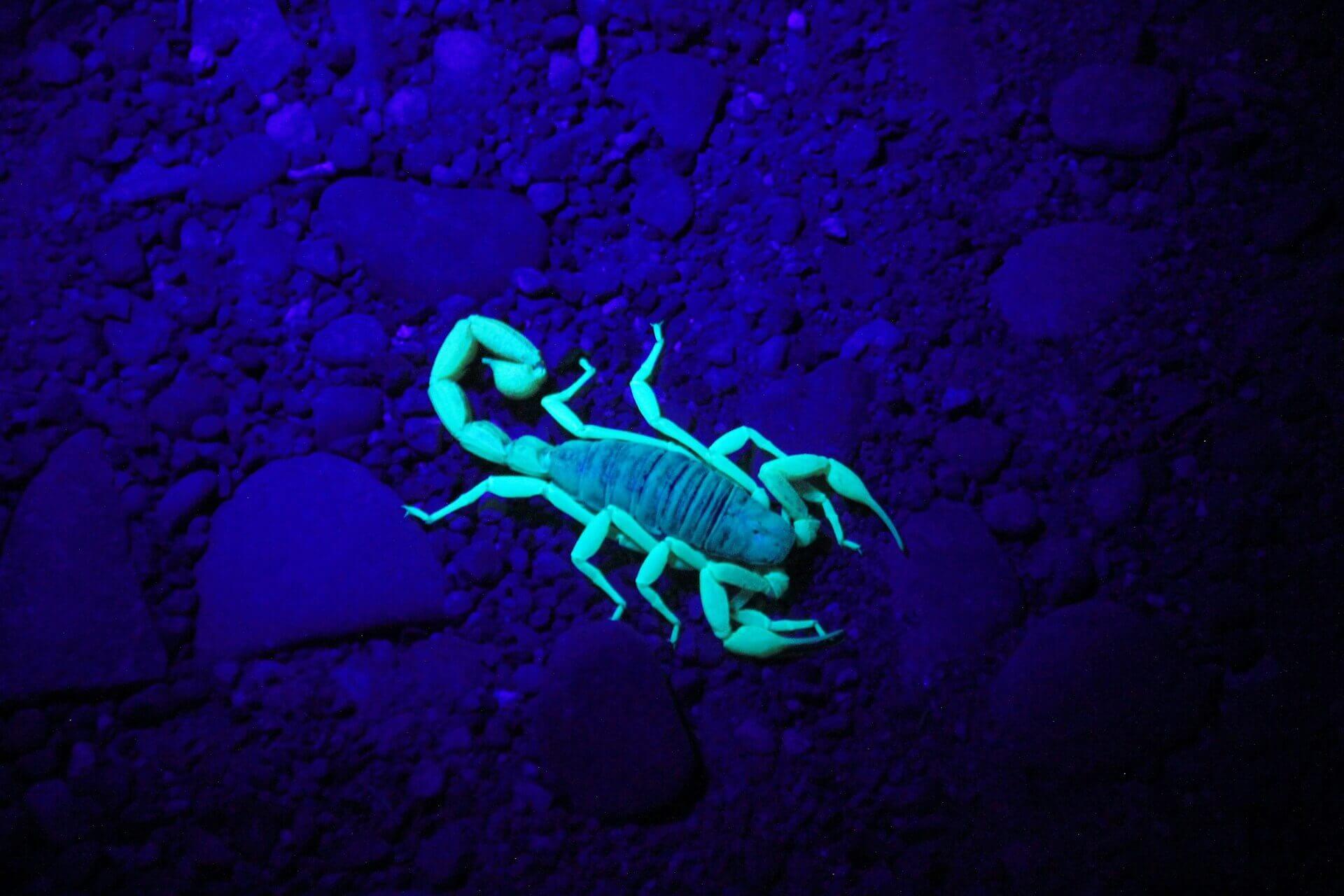
Walk through the desert at night with a UV flashlight, and you may witness something extraordinary. Tiny blue-green shapes suddenly appear across the ground.
They’re scorpions.
Unlike fireflies, scorpions don’t produce their own light. Instead, they glow through a process called fluorescence, one of the most fascinating mysteries in the animal kingdom.
Fluorescence, Not Bioluminescence
When ultraviolet (UV) light strikes a scorpion’s hard outer shell, special chemicals in its exoskeleton absorb the invisible rays and instantly re-emit them as a bright blue-green glow.
Without UV light, the glow disappears completely.
Scientists have found that almost every known scorpion species shares this unusual ability. The fluorescent compounds develop after each molt, becoming part of the hardened exoskeleton.
Why Do Scorpions Glow?
Despite decades of research, no one knows the exact answer.
Some scientists believe the glow helps scorpions detect moonlight and decide when it is safe to leave their shelters. Others suggest it may offer protection from harmful ultraviolet radiation. Another theory is that fluorescence is simply a by-product of chemicals that strengthen the exoskeleton.
So far, none of these explanations has been proven.
A Mystery That Continues Today
Although the purpose of fluorescence remains unknown, it has become an invaluable tool for researchers. With a simple UV flashlight, scientists can easily locate scorpions during nighttime field surveys, allowing them to study these secretive predators without disturbing their natural behavior.
More than 400 million years after the first scorpions appeared on Earth, they continue to surprise us. Their mysterious glow is a reminder that even some of the oldest animals on the planet still hold secrets waiting to be uncovered.